"mark indicating an omitted letter," 1580s, from French apostrophe, from Late Latin apostrophus, from Greek apostrophos (prosoidia) "(the accent of) turning away," thus, a mark showing where a letter has been omitted… In English, the mark often represents loss of -e- in -es, possessive ending. By 18c. it was being extended to all possessives, whether they ever had an -e- or not.
Thats not boring, is it? Its interesting! Wouldnt you folks’ like to hear more?
Some students struggle mightily with apostrophes in possessives and contractions, etc. Where does that pesky apostrophe go?? Which letter(s) does it replace?? To say nothing of whether or not the word even needs an apostrophe. Mistakes can create misunderstandings, a comprehension glitch. It is common for writers to mistake a plural (boys) for a possessive (the boy's backpack) for a contraction (this boy's so hungry). Writing aside, some readers do not know how to interpret the apostrophe.
To complicate the issue, an apostrophe has multiple uses: In addition to possessives and contractions, an apostrophe goes after a lowercase letter to make it plural. Watch your p’s and q’s. And don’t forget to dot your t’s! See the wise old Owl at Purdue’s writing lab for an interesting backstory on those p’s and q’s.
Note also the use of an apostrophe to hold the place of omitted numbers, as in '60s for 1960s, and the television program That '70s Show.
But the possessives and the contractions are paramount in terms of writing competency. Teachers must be very clear about the apostrophe. They must explicate the whys and the wherefores. That tiny notation has to pop!
Today, EDVIEW360 published a brief article I wrote on the importance of integrating phonics and phonological awareness lessons with morphological awareness lessons when teaching children to read. Based on growing evidence from empirical studies, I suggest beginning to teach morphological concepts at a younger age than previously thought. Begin in primary grades, after children learn basic closed-syllable short-vowel phonics patterns, when children are learning to spell and read. Let's not wait until grade four, but rather plan lessons in first grade and beyond to dovetail orthography with morphology. Carpe diem! See my article about this topic -- and many other good articles -- at EDVIEW360.
Next week, Wednesday May 8 at 4pm Central Time, I will provide a webinar on these same topics. Sign up at EdView360 at this link: Building Reading Skills in Grades 1-4
A few months ago, EDVIEW360 recorded my podcast on helping children learn to read. Listen to the podcast at Boosting Beginning Reading(and listen to other podcasts by many and varied experts in the field).
Plus, Silvereye Learning Resources is --even as we speak -- preparing to publish a new Third Edition of my morphology curriculum, Vocabulary Through Morphemes: Suffixes, Prefixes, and Roots for Intermediate and Secondary Grades. Cover art coming soon! I am pleased to announce that this curriculum has been in widespread use for more than two decades and will soon be back in publication again.
Also, Voyager Sopris Learning has recently (2024) published a new full-color Second Edition of my interactive decodable beginner books, Power Readers (K-2) and Supercharged Readers (more advanced decodable books). The black-and-white first editions are also still available for purchase. The new edition of Supercharged Readers includes 5 additional chapter books with a greater focus on morphological knowledge. All the new books are now in color, with even more coaching tips provided in small font at the bottom of each page. To see samples or to order, go to Power Readers and to Supercharged Readers.
MINDFULNESS is a noun composed of three morphemes, mind + ful + ness. It is an abstract noun, a nebulous quality, a characteristic, a psychological state, and in some sense, an entity. Abstract, invisible, untouchable. But its presence within a group or an individual, and its lack, can feel quite concrete.
According to Online Etymological Dictionary these concepts are not new. The word mindfulness has been in use for about five centuries and in the Buddhist sense for over a century. Mindless has been around six centuries or more. Note the Old English meaning ‘senseless, beside oneself, irrational, wanting power of thought.’ In terms of the plague, Europe would have known this state of mind.
The spread of covid 19 -- and the widely variable, rapidly changing information that surrounds it -- has spurred us to become more...or less...something. More vigilant. More reactive. More confused. Also more compassionate, more courageous, more mindful.
Literacy Activities at Home or at School
1. Students -- or entire families -- could discuss the meaning of mindfulness and its counterpart, mindlessness. Evaluate current affairs and news reports as exemplifying mindfulness or mindlessness, somewhere between the two, or something else entirely. Discuss your reasons.
2. Draw up a list of synonyms and near-synonyms for each word. Try out the Visual Thesaurus website. To learn how, check out the post Beware the Obscure Adjective at Wordshop.
3. Become artful. Play with color, font size, and positioning. Create a word cloud from news articles on coronavirus, using text copied and pasted into Wordle or any cloud-maker. For more ideas on how to use word clouds, refer to a previous post on Word Clouds, Key Concepts and History. Some word cloud programs allow the words to fit into shapes.
MORPHOLOGY ACTIVITIES
Discuss the image Mind Full, or Mindful?
What's the message? How does the morphological construction differ? How does the meaning differ?
Explore the morphology and etymology of mindfulness:
Explore the base mind and the suffixes -ful and -ness. Follow the links embedded in the text below and discuss the content and implications.
According to Online Etymology Dictionary, the word mind is a noun with its roots in Old English, Proto Germanic, and theoretically, it hails all the way back to one of the great ancestral mother tongue, ProtoIndoEuropean (PIE). The original meaning of of the concept was strongly associated with memory, remembering. Survival itself required a good memory.
mind: "that which feels, wills, and thinks; the intellect," late 12c., mynd, from Old English gemynd" memory, remembrance; state of being remembered; thought, purpose; conscious mind, intellect, intention"
Discuss morphologically related words like mindset, minding, unmindful, mastermind,etc.
Utilize the Word Searcher website, created by Neil Ramsden. Notice the spelling sometimes differs from American English, as the author is based in Europe. Type mind into the Word Searcher field. Find 27 words that include that base. Discuss the meanings of these words.
Explore words ending with the suffix -ful
Type ful$ into the Word Searcher bar -- the suffix (ful) followed by the dollar sign $ to indicate placement at the end of the word. I found 150 matches, including lawful, bagful, cupful, eyeful, baleful, needful, painful, gleeful, neglectful, disdainful, purposeful, teaspoonful. How are they alike and different? How could they be sorted into different groups?
Explore words ending with the suffix -ness
Utilize the Word Searcher website agin. Type ness$ into the search bar -- the suffix (ness) followed by the dollar sign $ to indicate placement at the end of the word. Notice again that the spelling sometimes differs from American English, as the author is based in Europe.
Try to decipher the meaning of previously unknown words by examining the morphological construction. For example, younger students might analyze and discuss shyness, goodness, grayness, wetness, silliness, swiftness, heaviness, etc. Note that most of the words generated through this search incorporate the suffix –ness, but a handful do not, as in lioness and patroness (lion + ess and patron + ness). So, to deal with that, play Will the Real Suffix Please Stand Up, as described in The Descriptive Suffix -ish.
Older students might discuss the meaning and usage of academic words found by Word Searcher, including conspicuousness, coyness, aptness, flirtatiousness, inquisitiveness, meaninglessness, neighborliness. Explore words ending with both suffixes -ful and -ness:
Type fulness$ into the search bar. Notice that the search engine only found 45 matches. Of those, some words are rarely used and may be unknown to the student but could be deciphered via morphological analysis and verified via the dictionary.
For example, consider three results: gratefulness, mournfulness, peacefulness. Of those three words, which one is easiest to decipher because the base is known and transparent? How does grate relate to the concept of appreciation, anyway? Is this a grate over a duct or what? Discuss gratitude. And grace. Key ingredients to achieving mindfulness. And to living in the present.
(Thank you for continuing to visit the site despite my absence. Note that I updated the archives link. The widget thingy had stopped working. For links to all posts, see "POSTS" under the picture of the Golden Gate Bridge, above.) Just a reminder to go out and vote, and a few words about the Latin root LECT as in elect, electing, elected, election, electives, and the related words select, collect, dialect, etc. Also, TED TALKS offers various perspectives on this election. See The Issues at Stake in the US Election of 2016. Now for affixes and roots. This graphic is just something I put together for fun, but hopefully it gets the point across. I expect there's plenty of creative expression going on in schools this week!
The prefix e- is an assimilated form of the well-known prefix ex-, meaning 'out, from' We see it also in erase, emerge, evaporate, etc. So to elect is to 'choose from a group or pick out' or something of that sense. Harper's Online Etymology Dictionary is free to all. He describes the origins of election below. Notice the religious sense and the reading sense:
election (n.) c. 1300, "act of choosing someone to occupy a position, elevation to office" (whether by one person or a body of electors); also "the holding of a vote by a body of electors; the time and place of such a vote," from Anglo-French eleccioun, Old French elecion "choice, election, selection" (12c.), from Latin electionem (nominative electio), noun of action from past participle stem of eligere "pick out, select," from ex- "out" (see ex-) + -ligere, comb. form of legere "to choose, read" (see lecture (n.)). Theological sense "God's choice of someone" for eternal life is from late 14c. Meaning "act of choosing, choice" is from c. 1400.
Above is a more exhaustive look at the root LECT along with various forms and interpretations, with oodles of relevant words. The screenshot is copied from Robertson's Word Info. Click on the link for MUCH more info. I cannot begin to imagine how long it took him to create this amazing reference tool. Notice that Robertson mentions the relationship between Latin and Greek. The Romans borrowed from the Greeks, so this is not surprising. And... Let's not forget the fun historical word snollygoster! I mentioned this before, but it's worth another look. Etymologist Mark Forsyth adds some humor to to the intensity of this election. If the video doesn't play, go directly to the TED page.
I begin with Mark Forsyth's entertaining video clip discussing the etymology of a few political terms and conclude with George Orwell's more serious essay on politics and communication.
A number of Vocabulogic posts have explored how words tend to change in form, meaning, and usage over time, referencing the study of etymology. For example, in one post I describe how the Common Core State Standards include the study of etymology in high school English classes. See Etymology and Morphology Standards. In another post, Shane Templeton discusses how word meanings change over time and are "more than the sum of their parts".
Along the same lines, I offer an interesting video, courtesy of TED Talks. With plenty of humor and some embellishment, etymologist Mark Forsyth makes the point that words change meaning based on the usage at the time. Try as we might, we cannot control word meaning, nor cast it in cement. It is likely to take on a life of its own. Speechifiers take note!
Forsyth states:
"Politicians try to pick words and use words to shape reality and control reality, but in fact, reality changes words far more than words can ever change reality.”
Forsyth discusses two political terms, snollygoster and president. What's a snollygoster? By the sound of the word, and knowing it is used to describe politicians, I suppose we can all guess.
Of more relevance, Forsyth explores how the term president came to reference the "chief executive officer for the US" and how its connotations have drastically changed since first applied to George Washington. The bit about the US Senate may be somewhat apocryphal, as some have suggested, but the story is entertaining and provides us with word-sleuthing material.
This short video might perhaps be interesting to secondary and tertiary students studying civics, US History, or etymology. The video runs 6.26 minutes, published June 2012. Watch it below, or view it directly at the site, TED.com.
Politicians and Language:
How do the words we use reflect our personality? James (Jamie) W. Pennebaker, a psychologist at the University of Texas, analyzed the speech patterns used during the debate between President Obama and Governor Romney. His analysis includes the use of pronouns and function words as well as content words and positively or negatively charged phrases. He compares the two candidates to former Presidents Clinton, Bush, and Reagan. View his brief interview at Wordwatcher, a You Tube channel hosted by UT Austin. You might be surprised at his analysis.
ALSO, if the relationship between words, ideas, and communication interests you, see George Orwell's essay, Politics and the English Language, published in 1946. I found it online, courtesy of Vincent Ferraro, Professor of International Politics at Mount Holyoke.
Citing five excerpts from various publications, Orwell shows how words can muddle our thinking -- how easily we can confuse ourselves and our audience with unclear language -- and not necessarily intentionally. But politicians on both sides of the aisle have been known to muddy the waters, as Orwell shows. He offers sound advice for anyone who wants to improve both their thought processes and their communication, concluding with the following statement:
Political language -- and with variations this is true of all political parties, from Conservatives to Anarchists -- is designed to make lies sound truthful and murder respectable, and to give an appearance of solidity to pure wind. One cannot change this all in a moment, but one can at least change one's own habits, and from time to time one can even, if one jeers loudly enough, send some worn-out and useless phrase -- some jackboot, Achilles' heel, hotbed, melting pot, acid test, veritable inferno, or other lump of verbal refuse -- into the dustbin, where it belongs.
The Common Core State Standards (CCSS) provide learning goals for grades K-12. These new objectives have been adopted by 45 states (see map). In this post, I discuss the CCSS that pertain to etymology and morphology and argue that the Standards do not adequately address etymology. I begin with the survey results and conclude with websites and books for teaching etymology.
The survey reveals a somewhat keen interest in word origins for more than half the respondents (72 of 127 voters). Given the readership of Vocabulogic, this is perhaps not surprising, but it is promising. If teachers are interested in something, students are more likely to become interested, too (especially if they like the teacher). In his classic work, Principles of Teaching, Thorndike (1906) suggested that the second cause of interest is the force of imitation; he argued that students will be interested in whatever interests the community—including their teachers and fellow students—and the interest will be acquired almost by infection.
DO THE STANDARDS INCLUDE MORPHOLOGY?
Yes, in the CCSS, the English Language Arts (ELA) Standards include morphological awareness (knowledge of word structure, especially via affixes and roots). While morphological awareness (MA) is never mentioned per se in the Standards, the related content is included as a sub-skill across every grade, K-12. However, to find the standards that apply to MA, one must search around a bit, hunting in
the various domains under ELA: Reading, Language,
Foundational Skills. Search for the terms inflectional endings, suffixes, prefixes, affixes, compound words, Greek and Latin roots. Below is one example standard, showing the morphology bits, from grade 3:
Determine or clarify the meaning of unknown and multiple-meaning word and phrases based on grade 3 reading and content, choosing flexibly from a range of strategies.
Determine the meaning of the new word formed when a known affix is added to a known word (e.g., agreeable/disagreeable, comfortable/uncomfortable, care/careless, heat/preheat).
Use a known root word as a clue to the meaning of an unknown word with the same root (e.g., company, companion).
WHAT ABOUT ETYMOLOGY?
Etymology is the study of how words have changed in form, meaning, and usage over time, including the origins of words--whether a word was first used by the ancient Greeks, for example. See prior post and see post by Shane Templeton.
Etymology is almost forgotten in the Common Core ELA Standards. The search term etymology appears only twice (!!) across the entire document, K-12. The search term word origins is not found at all. The standard first appears in grades 9-10 and repeats in grades 11-12:
Determine or clarify the meaning of unknown and multiple-meaning words and phrases based on grades 9–10 reading and content, choosing flexibly from a range of strategies.
Consult general and specialized reference materials (e.g., dictionaries, glossaries, thesauruses), both print and digital, to find the pronunciation of a word or determine or clarify its precise meaning, its part of speech, or its etymology.
Hmm. It seems to me that the etymology bit was almost an afterthought. The language is certainly not strong, and only applies to high school. Why is etymology given slight attention? I know not. But, in support of this decision, researchers have not sufficiently explored how etymological insight relates to either morphological insight, vocabulary knowledge, or even orthographic knowledge (how to spell).
On the other hand, learning about word histories might be viewed as one way to make the word stick. If we know why a word is so named, and have a sense of its history, we might better remember it. Vocabulary researcher Stephen Stahl explained it like this, in his book Vocabulary Development (1999, pp 22-23):
"Telling word stories can make words memorable. Knowing that bilious comes from the medieval humor, bile, which caused anger...makes the word more memorable"
Likewise, knowing that robot originally meant "forced laborer or slave' (from Czech robotnik "slave," from robota "forced labor, drudgery") makes the word far more interesting, more three dimensional, cognitively "sticky" or memorable, and infused with history. In my view, learning etymology reinforces the study of history, and the reverse is also true.
There is another reason to include word origins long before high school. English freely adopts foreign loan words (prior post). English contains words from dozens--if not hundreds--of other languages. It is important to be aware of this fact, especially from a spelling perspective.
IMPLICATIONS for INSTRUCTION
I would not suggest spending a lot of time on word histories, but I see no reason to wait until high school to integrate the history of the word into the vocabulary lesson--with the caveat that this need only happen occasionally, and only if the etymology is interesting. Likewise, why not infuse etymology lessons into history lessons, where applicable and interesting?
Students might start exploring brief word histories as soon as they have a sense of the world and can read a world map--certainly by fourth grade. This should help them remember meanings, spell words, and pronounce words. Perhaps learning about word histories will help students realize that English is only one of many languages of the world. Indeed, it might help them become interested in learning another language.
RESOURCES: BOOKS AND WEBSITES FOR TEACHING ETYMOLOGY
Abracadabera to Zombie: More Than 300 Wacky Word Origins by Don and Pam Wulffson (short and sweet little etymologies, aimed at about grade 4)
Frindle, a chapter book aimed at about 5th grade, by Andrew Clements (fast paced and fun, used by many teachers)
A History of English in its Own Words, by Craig Carver (word histories provided, organized by time period: Anglo Saxon/Old English, French-based Middle English, Renaissance, etc.)
The Professor and the Madman: A Tale of Murder, Insanity, and the Making of the Oxford Dictionary, aimed at older students or adults, by Simon Winchester (a riveting read)
Learning objectives that pertain to both etymological and morphological
insight are integrated into the Common Core State Standards--learning standards adopted by 45 of 50 states. I will compare how the two types of linguistic insight are addressed in the Common Core, by grade level, in the next post.
For today, I offer an illustrated (and tongue-in-cheek) look at etymology, followed by a survey question. Scroll down for the emedded survey, or respond directly at Twiigs Polls.
Etymology is the study of how words have changed in form and meaning over time, including word origins.
For example, in Old English pretty was spelled a variety of ways, including, but not limited to, pæti, pætig, and prættig. The pronunciation differed from that of today, and so did the meaning: It originally meant "cunning or crafty."
Several centuries later, during Middle English, pretty described a more positive trait: "clever, skillful, or able" (Oxford English Dictionary, online).
Gradually, pretty morphed again, to indicate "pleasing in appearance." It is sometimes used in the diminutive, endearing sense (hmm...is that how she intended it?)
Pretty is also used as an intensifier, much like we use fairly or moderately:
"A pretty cold day in July" (...in San Francisco, of course).
It can be interesting to think about why the meaning of a word changed. How did pretty segue from "cunning" to "skillful" to "good looking?" Sometimes, just by pondering, we can get somewhere.
Etymology also includes the origins of words--whether a word -- in some form or another -- was first used by the ancient Etruscans, for example.
In My Big Fat Greek Wedding, Toula’s father, Gus, tries to connect every English word to that of a Greek word, including arachnophobia (yes) andkimono(huh??). Video clip here.
That was one of my favorite scenes (along with about 30 other hilarious bits). But Gus may be onto something, for while the Japanese word kimono is not traced to Greek roots, the Japanese word karaokeis, to limited extent. Karaoke is a "portmanteau word" or "linguistic blend" formed when words are smashed together, leaving some letters out during the collision (see prior post). In karaoke, kara is Japanese for "empty" and oke is the remaining bit that is leftover from the Japanese ōkesutora "orchestra."
BUT!! Gus would be quick to explain that orchestra flows from Greek roots, so karaoke must come from Greece, and he would be (partly) correct.
The Online Etymology Dictionary indicates that orchestra is from Latin orchestra, from Greek orkhestra, a semicircular space where the chorus of dancers performed, with suffix -tra denoting place + orkheisthai meaning "to dance."
Gus: "You see: orchestra, karaoke. There you go!"
By the way, kara is also seen in the Japanese word karate, where kara means "empty" and te indicates "hand" -- "empty handed" or weaponless, in a sense.
Enough said for now. Next time, the results of the survey and more information about etymology and the Common Core Standards.
NEW SURVEY QUESTION
Do you give much thought to the origins of the words you use? Do you wonder if a word or phrase hails from Jamaica or Japan? From Haiti, Hungary, or the Hawaiian Islands? Does this knowledge help you with spelling or pronunciation, for example? Vote below, or take the survey at Twiigs Polls.
One day, gasoline was labeled "inflammable" and the next, "flammable" and "extremely flammable." Or so it seemed.
I was unaware of this change until it reached a critical mass. It may have seemed sudden, but the transition from inflammable to flammable took several decades. The Ngram, graphed below and discussed by The Grammarist, shows that flammable overtook inflammable somewhere around 1978, at least in the publications Google includes in their corpus.
The change occurred to avert possible misinterpretation of the danger signs. (Tap on the graph curve to show stats by year.)
So, inflammable
is in transition, losing its prefix in-. In American-English, the transition is nearly complete. However, the related derivations retain the prefix, as with inflammatory, inflammation, inflammability. This word is also related through the root to inflame, inflaming, and the French loan words flambeau, flambé and flamboyant. See more words from the FLAM root family at Word Info. (See comments for discussion of possible spelling of base as FLAMM.)
Misinterpretation occurred because of the prefix in-. The word inflammable is parsed into in- + flam + -able. The root FLAM denotes 'to kindle, to set on fire, to burn.' This word came to English via Latin by way of French. The prefix in- comes in several spelling forms: in- (indirect), im- (improper), il- (illegal), and ir- (irreligious).
The prefix in- has three meanings or interpretations. The most commonly used sense conveys 'not' or 'non' as in insensitive, inedible, illegal, implausible, irreverent, etc.
The secondary meaning for the prefix in- is 'into, in, on, upon' as in insert, incandescent, and implant.
The third sense of the prefix is qualitative. Sometimes it serves as an intensifier, much like we use very or extremely.
So, basing word meaning strictly on the meanings of each morpheme, inflammable could be interpreted in three possible ways:
'not flammable'
'flammable from within, able to burst into flame'
'extremely flammable'
The second and perhaps even the third options are correct; inflammable indicates that something is "flammable from within, able to burst into flame, able to be set on fire." See Online Etymology Dictionary.
But apparently, and understandably, some folks thought inflammable meant 'not flammable' just as inedible means 'not edible.' So, the decision was made to change the danger signs. Gasoline and other combustibles are fairly consistently labeled FLAMMABLE. Today, FLAMMABLE and INFLAMMABLE are synonyms. They mean the same thing. They both warn of fire. But FLAMMABLE is seen far more frequently.
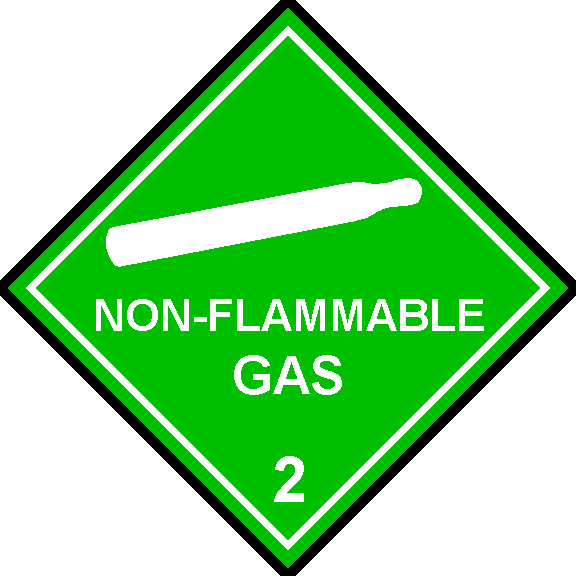
To make meaning quite clear, non-combustible materials that are not flammable are now termed non-flammable, thus avoiding the polysemous prefix in- completely. Why muddy the waters with the negative sense of the prefix in- when we have only just clarified things? And using green for the signage helps to convey the meaning. A safe color, green is go.
FLAMMABLE = INFLAMMABLE = FIRE RISK
Because inflammable derives from Latin, it is likely to have some look-alikes or cognates across the Romance languages. But when it changed to flammable in English, did it also change in Spanish? In French? In Italian? Not so much. See signs.
To
reduce confusion, perhaps we should just do away with words and communicate through pictures, icons,
signs. This involves semiotics, the study of how signs, symbols, and icons are
interpreted and used to convey meaning. A sort of "sign-ology" (not to
be confused with scientology).
Before Bill Bryson kindled my interest in morphology and word origins with his engaging if not authoritative book, The Mother Tongue: English and How it Got That Way, I assumed inflammable was just a poorly constructed word. I did not realize that the prefix in- had more than one meaning; instead, I consistently interpreted the prefix to mean 'not'.
But
take note! This confusion did NOT cause me to underestimate the
danger, spelled out on red cans and orange signs: Given what I know
about the world (ah, so we infer!) and particularly about gasoline, I
decided I would simply have to ignore the pesky prefix and go with my gut. Those gas pumps are gonna readily burn even though the warning sign does not seem to
indicate so.
Perhaps my own coming to terms with inflammable sheds a little light on how we all
process language. When it comes to words, one of the questions linguists
debate is which is
processed first or the fastest and/or to the greatest extent, the whole word or the morphemes that make up the word? Well, both, actually. In
addition, it is context that floats our language boat. Thus, one of my
favorite reads: In the Beginning was the Word (Aronoff, 2007) and, I dare to add, "In the End, the Word" and "Along the Way, the Morphemes."
Implications for Teaching Vocabulary: Teach students whole words. Also, teach them morphology (prefixes especially). Teach them to pay close attention to context. Help them learn to trust their own gut--to develop self-efficacy when interpreting word meanings, by drawing clues from context and from morphemes, and from knowledge of the world. Also, teach them to use a dictionary when needed. This aligns with the Common Core State Standards for English Language Arts. Here is an example from grade 5:
COMMON CORE STANDARD: Vocabulary Acquisition and Use
L.5.4.
Determine or clarify the meaning of unknown and multiple-meaning words and phrases based on grade 5 reading and content, choosing flexibly from a range of strategies.
Use context (e.g., cause/effect relationships and comparisons in text) as a clue to the meaning of a word or phrase.
Use common, grade-appropriate Greek and Latin affixes and roots as clues to the meaning of a word (e.g., photograph, photosynthesis).
Consult reference materials (e.g., dictionaries, glossaries, thesauruses), both print and digital, to find the pronunciation and determine or clarify the precise meaning of key words and phrases.
Also, encourage students to read, especially during the summer. Play word games (so many cool apps for word play--my newest fave is "4 Pics 1 Word"). Kindle interest in words, phrases, and language in general.
I will no longer send out email notification for each new Vocabulogic post. If you wish to be notified when a new post is published, enter your email address into Feedburner. After you do so, Feedburner will send you a verification email; you will need to confirm to activate your subscription. To subscribe, click the Feedburner link.
Greetings!
I am on holiday, so I did not write a post.
But be not dismayed!
(A curious word--dismayed--composed of dis- + may. With the prefix dis- denoting 'not, opposite of, away' and the forerunner to one sense of may historically denoting 'might, power, ability' (Ayto, 1990) we see that dismayed indicated far more than mere "disappointment" or "shock and surprise" as sometimes used today. For one example, a Google search yielded, "I was dismayed when the TV show was cut."
The Oxford English Dictionary defines dismay:
1.
trans (verb). To deprive of moral courage at the prospect of peril or
trouble; to appal [sic] or paralyze with fear or the feeling of being
undone; utterly to discourage, daunt, or dishearten. refl. †To be filled
with dismay; to lose courage entirely.
Be not *dismighted.
Ahem. But maybe a look at dismay is fitting for Memorial Day.)
Instead of writing a post, I offer two treats:
#1 : How Students Approach New Words (podcast)
Click this hyperlink
to visit the Voice of Literacy podcast page, where Dr. Betsy Baker
(University of Missouri ) interviews Dr. Jocelyn Folk (Kent State University). The run
time is just over 13 minutes.
Dr. Jocelyn Folk is a cognitive psychologist. She investigates incidental vocabulary learning among skilled readers. In the podcast, Dr. Folk explains:
"I have always been interested in the processes skilled readers use when they encounter a word that is unfamiliar to them--so it's a new vocabulary word--but that is not your task--your task isn't about learning new vocabulary words, you are just reading a book. So the question is this: How do skilled readers deal with words they do not know?"
#2: The Humorous Option
View a fast and furious video outlining the convoluted history of the English language. This clever video is courtesy of The Open University. If the video does not open in the player below, click one of the links beneath the video.
View the video in ten one-minute segments, at The Open University or view the entire ten-minute video on YouTube
Ayto, John. (1990). Dictionary of word origins. New York: Arcade Publishing.
Baker, E. A. & Folk, J. (2012, April 2). Vocabulary instruction: How students approach new words. Voice of Literacy. Podcast retrieved from http://voiceofliteracy.org
Peter Bowers contributed the following post. Pete is a doctoral candidate at Queen's University, Canada, with expertise in orthography and morphology, as well as critical thinking. He has investigated how morphological awareness contributes to various aspects of literacy, especially spelling and vocabulary knowledge. As a regular contributor to Vocabulogic, Pete has authored several posts, including Structured Word Inquiry and Meta-Analysis of Morphological Intervention Studies. Visit Pete's website: WordWorks Literacy Centre.
Current research has converged on the finding that literacy instruction should address morphology from the beginning of instruction and that this is especially important for less able students (Bowers, Kirby & Deacon, 2010; Carlisle, 2010; Goodwin & Ahn, 2010; Reed, 2008).
Given this evidence, the question facing educators and researches is not whether we should teach morphology, but how to teach it.
Structured word inquiry (Bowers & Kirby, 2010) is an instructional approach that targets exactly this goal. I regularly receive anecdotal reports from teachers and tutors reporting examples of this effect, such as this account of a student-led investigation of the word condensation. As well, our controlled intervention study using this approach (Bowers & Kirby, 2010) showed that morphological instruction using the structured word inquiry approach brought significant vocabulary gains for words that were not explicitly taught, but which shared a base with explicitly taught words.
It is a challenge to explain what structured word inquiry is clearly and to convey how it operates in classrooms in writing. For that reason, I am delighted that Susan has invited me to share a few videos that provide a big picture of this instruction and which illustrate this instruction in action in real classrooms.
This public lecture on structured word inquiry provides a useful "big picture" of this instruction. The video is from a talk I gave for the J.P.Das Centre on Developmental and Learning Disabilities at the University of Alberta.
This video shows aninvestigation of the spelling of the word does in an elementary classroom.
This video shows a lesson introducing the central linguistic tools of structured word inquiry, the morphological word sum and matrix to a kindergarten class.
To explore other videos illustrating this instruction in action in classrooms around the world, visit this YouTube channel.
My hope is that these videos will motivate Vocabulogic readers to have a go at morphological analysis using matrices and word sums. There are many free resources available atwww.wordwordskingston.com to help you get started.
At this link, you will learn about a new piece of software called The Word Microscope (that is currently free to download) that you can use to start these types of investigations on your own and with your students.
Finally, if I were to recommend one article that lays out the underlying principles of how English spelling works that are revealed through structured word inquiry with the matrix and the word sum, it would be Carol Chomsky's seminal 1970 paper, "Reading, writing, and phonology" in Harvard Educational Review.
References
Berninger, V.W., Abbott, R.D., Nagy, W., & Carlisle, J. (2010).Growth in phonological, orthographic, and morphological awareness in grades 1 to 6. Journal of Psycholinguistic Research, 39, 141–163.
Bowers, P. N., & Kirby, J. R. (2010). Effects of morphological instruction on vocabulary acquisition. Reading and Writing: An Interdisciplinary Journal, 23, 515–537.
Bowers, P. N., Kirby, J. R., & Deacon, S. H. (2010). The effects of morphological instruction on literacy skills: A systematic review of the literature. Review of Educational Research, 80, 144–179.
Carlisle, F. (2010). Effects of instruction in morphological awareness on literacy achievement: An integrative review. Reading Research Quarterly, 45, 464–487.
Chomsky, C. (1970). Reading, writing, and phonology. Harvard Educational Review, 4(2), 287–309.
Goodwin, A.P., & Ahn, S., (2010). A meta-analysis of morphological interventions: effects on literacy achievement of children with literacy difficulties. Annals of Dyslexia, 60, 183-208.
Reed, D.K. (2008). A synthesis of morphology interventions and effects on reading outcomes for students in grades K–12. Learning Disabilities Research & Practice, 23(1), 36–49.
Thanks for participating in the Puzzling Plurals survey. In this post, after focusing on potato and other singular nouns that end with the open /o/ sound, I discuss the survey questions. To finish, I provide links to references, articles, and games.
It is evident from the survey results that "we" are perplexed. The English language is puzzling, and plurals trouble all of us at times. As we know, they can certainly stress former US Vice Presidents--at least, that's the argument I make below.
"Now add one little bit on the end."
Some tricky singular-plural pairs are remnants of Old English, and flow
from the Germanic layer of the language. Some are artifacts of Greek and
Latin influence. Still others flow from Japanese, Arabic, Spanish,
etc.
For example, take potato, a word that apparently traveled from native Haitian, was given a Spanish spelling, and was adopted into English, from Sp. patata, from Carib (Haiti) batata "sweet potato." (etymology here). Basic English 101 says to make a plural, we add either the inflectional suffix -s or -es to the singular noun, right? But we typically add -es to words that end with hissing sibilant sounds like /s/, /z/, /sh/, /zh/ and /ch/ -- including wish-wishes, fox-foxes, and bus-buses. Now, potato does not end with a hissing sound, so why would the plural of potato be potato + es? We do not add an -es to pinto or pueblo, yet like potato, they came into English via Spanish. And if the plural is potatoes (and it is), then we should be able to figure out how to spell the singular simply by removing the final -s. Thus, we might deduce that the singular of potatoes is *potatoe. After all, someone (a teacher, or so the story goes) spelled it that way on the cue card for the ill-famed spelling bee. (See the *potatoe incident on YouTube.)
One can kinda-sorta see why Quayle's handler approved the cue card, and why the VP himself went along with it, telling the 12-year-old--who knew the correct spelling--to "add one little bit to the end" of his perfectly spelled potato. After all, there are just too many strange spellings to remember, and we never add -es to a noun that ends in a vowel.
But we do! Potato+es, echo+es, torpedo+es, tomato+es, and hero+es testify to it, while piano+s, inferno+s, video+s, rodeo+s and bistro+s refute it. Meanwhile, playing it safe, several sit the fence: ghettos or ghettoes, cargoes or cargos, flamingos or flamingoes, halos or haloes, tornadoes or tornados, etc. English is pickled with puzzles, and just when we find a pattern, the language genie attacks--sometimes we tangle with two genies at once--or genii?
I spell potato, you spell *potatoe? Pity the former Vice President, but pity even more the millions of English learners around the world. In fact, be gentle with all. From the survey results, even well-educated adults who use English with confidence all day fall prey to the unpredictable plural.
Below, I briefly discuss the survey questions. I note the percentage of 271 respondents who voted in favor of each phrase, deciding it was correct. Kudos (but not *kudoes) for resisting the dictionary while responding. Refer to the prior post to see the closed survey with graphed results and related comments.
(82%) lots of data is correct. The singular is datum.
(55%) seven thesauri is correct. Thesauruses is listed in some dictionaries, but it only appears once every 1,356,110 pages, on average, according to Vocabulary.com. The singular is thesaurus.
(63%) a single bacterium is correct (like datum). The plural is bacteria.
(12%) six skinny mooses is not correct. The plural of moose is moose.
(38%) one essential criteria is not correct. The singular is criterion; theplural is criteria.
(26%) five octopuses is correct. Read about octopuses, not *octopi, below.
(85%) four strong oxen is correct (like children, brethren, and extinct shoon, like shoe + -en; see shoe etymology). The singular is ox.
(63%) two loaded dice is correct. The singular is die (but dice is becoming more accepted as a singular form). Note the plural mice and lice are not expressed in singular as *mie and *lie.
(89%) four flying fish is correct, but fishes would also be correct.
(71%) a strange phenomenon is correct (like criterion). The plural is phenomena.
(77%) some differing hypotheses is correct, ending with es. The singular is hypothesis (like crisis, analysis, thesis, parenthesis).
(13%) hundreds of hopping head lie is not correct. The plural is lice and the singular louse (like mouse, but not house and *hice)
English words reflect the spelling patterns of the parent language, but not with consistency. This is when we teach dictionary skills, an important aspect of vocabulary instruction. However, it is worthwhile to memorize the spellings of words we use frequently. Many of these words actually do conform to a plural-forming pattern. In Words and Rules, Stephen Pinker (1999, p. 26) theorized:
"The mind analyzes every stretch of language as some mixture of memorized chunks and rule-governed assemblies."
Rule-governed assemblies include spelling patterns. What are the spelling patterns for tricky plurals? Several experts have attempted to explain them, or list them. So, for your browsing pleasure, explore the following links -- there's even a game.
Tangled up in the coils of the language octopus
X Sea lions are carnivores and eat fish, squid, octopi, crabs, clams, and lobsters.
As the above example (taken from a US scientific publication) shows, a little knowledge of Latin and Greek can be a dangerous thing and sometimes leads people into error. The writer clearly knows that some Latin plurals are formed by changing the ‘–us’ ending of a singular noun into ‘-i’ for the plural, as in alumnus -> alumni. However, octopus is ultimately borrowed from a Greek word and not a Latin one, so it’s incorrect to form the plural according to the Latin rules. If you wanted to be ultra-correct and conform to ancient Greek, you’d talk about octopodes, but this is very rare: the Anglicized plural, octopuses, is absolutely fine.
In this post, I provide asimplified account of the birth and evolution of the English language. This account might be explored in chunks, with a map at hand. Start with this fast-paced video: THE HISTORY OF ENGLISH, IN TEN MINUTES:
This modified excerpt is from Vocabulary Through Morphemes, Second Edition (Ebbers, 2011). The book includes pictures, charts, etc.
Invaders of the English Language
England is on an island in the North Atlantic. This island has rich soil, good for farming. Rivers flow across the fertile land, good for fishing and irrigating. Plants and animals thrive. Under the ground, mines yield coal, copper, and iron. This rich country is somewhat protected from invaders because it is surrounded by water. In brief, it is a fine place to raise a family and build a nation.
THE CELTS
Long ago, Celtic tribes, called Britons, lived on this fertile island. Unfortunately, the Celts (pronounced /kelts/) lived in many tribes without one united army. This made them somewhat defenseless to larger armies. This made their island vulnerable to attack.
THE ROMANS
Roman soldiers successfully invaded the island in the year 43A.D. Romans spoke Latin. The Romans called the island Britannia, named after the Britons they found living there. The Romans built roads, walls, cities, and castles. Actually, they forced the Britons to do most of the construction work, and to farm the land and dig in the mines, laboring for the Roman empire. The Britons and Romans lived peacefully together most of the time. However, a few famous Celtic leaders battled the Romans, including Queen Boudicca (also spelled Boadicea) and possibly the legendary King Arthur. The Romans defeated the Celtic Britons. Rome ruled.
Slowly, the Roman Empire began to weaken. By the year 410, Rome “fell” into the hands of invaders. The Roman soldiers left Britannia and hurried home to protect their city of Rome, in Italy. The Celtic Britons remained on Britannia. After nearly 400 years of Roman rule, the island belonged to the Britons again.
THE ANGLO-SAXONS (the birth of English, from Germanic languages)
The civilized Celts still lived in tribes with no united army, and their island was still green and fertile. Neighbors still wanted it. Thus, around the year 450, Germanic tribes from across the water invaded. The Germanic invaders were the Angles and Saxons (called the Anglo-Saxons) and the Jutes. These barbaric Germanic pirates took control of Britannia, harming the Celtic Britons terribly, burning their homes and villages and killing or enslaving them. Many Celts fled to Scotland and Wales and France. Only a handful of their words are found in the English language. The ThamesRiver and the cities of London, Dover, and Kent are probably named after Celtic tribes or chieftains. The words clan, crag, and wraith may also derive from Celtic origins, but this is not certain.
From the tribal name Angle (the Angles) came the words England and English. Thus, the English language was born about 1,500 years ago as a Germanic language. Only a fraction of the Old English words exist today, including live, love, heaven, fight, good, evil, man, wife, child, sleep, eat, house, stone, rain, one, two, three, green, black, the, an, to, for, but, around, will, do, and, with, and compound words like mankind and blackbird. These English words came from Germanic languages.
THE VIKINGS
The island suffered yet another invasion, bringing changes to the English language. In about 787, the Vikings invaded. The Vikings lived across the water, in Scandinavia (the Norsemen lived in Norway and the Danes lived in Denmark). These Scandinavian Vikings spoke another form of German and were excellent sailors. They invaded Britain, arriving on countless Viking ships. Pirates again! (Remember, the Angles and Saxons had once been pirates, driving out the Celts 200 years earlier.) The Germanic-speaking Vikings raided the Anglo-Saxon villages in England repeatedly and brutally for more than 100 years. Finally, King Alfred the Great brought about peace between the Anglo-Saxons and the Vikings. Alfred was the only English king to be named “Great” (his name, Alfred, meant ‘elf counsel’). The English married the Scandinavian Danes and Norsemen. Their Germanic languages blended into English. A multitude of Norse words were adopted into English, including freckle, leg, skull, skirt, skin, sky, egg, score, scream, and cake. By the year 1000, Old English contained thousands of Germanic words, absorbed from the Angles, Saxons, Jutes, and Scandinavians.
THE NORMAN FRENCH
Still another invasion occurred in 1066. William the Conqueror was a French nobleman from Normandy, France. He led his Norman soldiers to defeat the English at the Battle of Hastings, in 1066. William the Conqueror was crowned King of England. For 300 years his followers, the Norman French, ruled England. They built great castles and cathedrals. For 300 years, every English king spoke French. All the English landowners were ordered to speak French, too. French was the only official language allowed in court, government, and medicine. Latin was used for education and worship. Meanwhile, the poor folk continued to speak Germanic words like love, live, and laugh. The Germanic portion of the English language survived mainly because of peasants and serfs, but thousands of Germanic words were lost in these centuries.
French flows from the Latin language of the Romans. Thus, the conquering Normans brought a multitude of French words with Latin roots into the English language, including please, sign, very, peace, nobility, felony, attorney, government, parliament, justice, chivalry, court, courtesy, courage, beef, bacon, baptize, flower, power, royal, annoy, and joy.
Gradually, the French-speaking Normans intermarried with the Anglo-Saxon English. Eventually, battles between France and England broke out. By about 1400, the French language was rejected and the English language was back in business and back on the throne. However, it was not Old English. After the Norman invasion it developed into Middle English. Middle English was far more expansive, having gained more than 10,000 French words. Middle English was also simpler, having lost many of the rules of grammar that complicated Old English.
THE PRINTING PRESS
Early Modern English began soon after Johannes Gutenberg invented the printing press in Germany in 1436. With the printing press came books, instead of scrolls and manuscripts written by hand. William Caxton set up a printing press in London in 1476. The press brought greater consistency to the English language. Spelling rules emerged. Before the press there were at least 12 ways to spell the word egg, depending on the dialect. After the press, spelling was more consistent. More people learned to read and write. Bibles and other books were written in English instead of Latin, starting with Tyndale’s Bible in 1525 and the King James Bible in 1611. Dozens of plays were written by William Shakespeare, including Romeo and Juliet. By the end of the sixteenth century, more than 1,500 new words and phrases had entered the English language, penned by the famous playwright, including swagger, gloomy, zany, and bedroom. As more books were published, the English language continued to grow. Eventually, dictionaries were written, to record the words and their spellings.
THE RENAISSANCE
At about the same time as the invention of the printing press, a great Renaissance began in Italy and swept across Europe, reaching England by 1500. The Renaissance was a kind of rebirth, a time of fresh new thinking, a bright, hope-filled period. Renaissance thinkers included Leonardo da Vinci, Michelangelo, Sir Isaac Newton, Galileo, and many more. Artists, musicians, mathematicians, and scientists created marvelous sculptures, paintings, symphonies, calculations, formulas, and inventions. As a result of this explosion of creative energy and insight, many Greek, Latin, French, and Italian words entered the English language. (A great many words used in science and the arts flow from ancient Greek roots, including telescope, astronomer, biology, physics, electricity, psychology, geothermal, dinosaur, museum, orchestra, symphony, lexicon, apostrophe, and paragraph.) The Renaissance spanned several centuries. At least 10,000 English words were born during the Renaissance, bearing witness to the enlightenment of the time.
GLOBAL EXPANSION
England grew rich and powerful, as the English sailed the seas, charted the globe, and colonized various parts of the world, much like the Romans had done nearly two millennia before. Thus, in those days, English absorbed words from more than 50 other languages. From native tribes in Haiti and North America came words like teepee, toboggan, tomato, potato, tobacco, woodchuck, moose, and canoe.
English is still absorbing new words today, including an abundance of Spanish words. Because of the World Wide Web, the English word bank grows very quickly indeed. English is one of the largest and most widespread languages in the world.
Source: Modified from Vocabulary Through Morphemes: Suffixes, Prefixes, and Roots for Intermediate and Secondary Grades, Second Edition (Ebbers, 2011), published by Sopris West, Cambium Learning.