Showing posts with label Common Core State Standards. Show all posts

Sunday, July 7, 2013

Mindful Zen of Morphology, revisited


We strolled the San Francisco wharf, stopping at the National Historic Park Maritime Museum and checking out the ships on the Hyde Street Pier. Near Aquatic Park we approached this refreshingly pungent tree.

Click the tree image. It will grow.

BIG ★ BIGGER BIGGEST

According to the Common Core State Standards, children in kindergarten and first grade must learn how common inflectional suffixes like -s, -ed, -ing, -er and -est create various forms of the same word, as with grow, grows, growing, and big, bigger, biggest.

But inflections are only the beginning. The inflectional suffix -er in greener and brighter is not the same as the derivational suffix -er in painter and preacher. (See The Slippery Suffix -er.)

By third grade, students need to be working with derived words, particularly those countless English words formed by adding a derivational suffix. (Read about suffixes.)

TREE ★ TREELET

Finding a semantic overlap  between tree and treelet is a matter of morphological problem solving (Anglin, 1993). This involves knowledge of prefixes and suffixes, and a readiness to seek similarities in form and meaning across words. It also involves analogy: "I know what  a piglet is, so I can guess what a treelet is." The ability to problem solve via analogies or morphemes is facilitated by knowledge of similar words: booklet, owlet, piglet, eaglet, and applet, a small computer application.

Eventually, if students are shown how to explore morphological connections and taught common prefixes and suffixes, they become more apt to seek that satisfying "ah-ha" moment, when word meanings click into place. It's often quite rewarding, like the snap of a puzzle piece. This moment is more likely to happen when students are reading, rather than listening.

BRIG ★ BRIGANTINE

Photographed at San Francisco National Maritime Museum
Along our walk we visited this fabulous -- and free -- museum. Of course, I began to wonder about these two words, given their close proximity on the display. My first thought was that the root brig might mean "ship"...

...but in addition to brig and brigantine, we have brigadier and brigade. Are they all part of the same family of words? (So then I thought the root meant either "ship" or 'to fight').

Asking the question is important. Coming up with an answer is secondary to asking the question. Are students asking the question? Are teachers modeling this habit of thought?

So!

In kindergarten, analyze words like big, bigger, and biggest (inflections).
Also analyze tip, tipping, and tipped (inflections).

By first grade, birdhouse, doghouse, and -- not quite the same pattern -- tree house (These are compound words, but notice a tree does not live in a tree house, unlike the birdhouse and doghouse examples. Also, a tree house is an open compound, rather than closed.)

Explore how meanings change in words derived from a known base: pig-piglet, owl-owlet, and tree-treelet.

Into middle school and beyond, address more complex derivations: brig, brigantine, brigand, brigadier, brigandage, etc. The word brig is perhaps a clip, a shortened form of brigantine. However, brig has developed a unique meaning over the years. By the way, according to Online Etymology Dictionary, the root does mean "to fight" (Middle English via Italian).

According to seminal research by Jeremy Anglin (1993), inferring word meaning via morphological reasoning predicts vocabulary growth. Anglin tested children in grades 1, 3, and 5, finding a sharp increase in word knowledge between grades 3 and 5. He suggested that this steep increase is largely due to increased awareness of the process of suffixation, in particular, the process of creating new words by adding derivational suffixes. Those students who were more skilled in this type of "morphological problem solving" performed comparatively better on the vocabulary test.

While root words (words that have no prefix or suffix attached, like shoe, rope, tree) accounted for the most words known by the average first grade student, derived words accounted for the most words known by a typical fifth grader.

The chart is from Anglin's monograph. His test included treelet, among other words. I added some color and the other forms of tree as examples only, providing an instance of each of the five types of words he included in the test: root words, inflected words, derived words, literal compounds, idioms.


In the years since Anglin's monograph, the relationship between linguistic insight and literacy has become a fairly hot topic in research circles. Not surprisingly, Berninger et al. (2010) found a similar linear relationship between vocabulary knowledge and morphological insight, in large part confirming Anglin's findings.

Promising research by Bauman et al. (2007) suggests that vocabulary increases as a result of a combined instructional focus that includes four components: 1) creating a language-rich learning environment, 2) providing explicit word instruction, 3) teaching word-learning strategies (including inferring meaning via morphological problem solving), and 4) fostering word consciousness. This line of inquiry is based on theories advanced by Graves (2006).  See the MCVIP post, where a large team of researchers describe even newer findings.

The more our vocabulary grows, the more we are able to make connections when practicing The Mindful Zen of Morphology. The more we make connections, the more our vocabulary grows.

References:

Anglin, J.M. (1993). Vocabulary development: A morphological analysis. Monographs of the Society for Research in Child Development, 58(10), v-165. 


Baumann, J.F., Ware, D., & Edwards, E.C. (2007). “Bumping into spicy, tasty words that catch your tongue:” A formative experiment on vocabulary instruction. The Reading Teacher, 61(2), 108-122.

Berninger, V. W., Abbott, R. D., Nagy, W., & Carlisle, J. (2010). Growth in phonological, orthographic, and morphological awareness in grades 1 to 6. Journal of Psycholinguistic Research, 39(2), 141-163.

Graves, M. F. (2006). The vocabulary book: Learning and instruction. New York: Teachers College Press.
 
Nagy, W.E. (2007). Metalinguistic awareness and the vocabulary-comprehension connection. In R.K. Wagner, A.E Muse, & K.R. Tannenbaum (Eds.), Vocabulary acquisition: Implications for reading comprehension (pp. 52-77). New York: Guilford Press. 


To be notified when a new post is published, enter your email address into Feedburner.
When Feedburner sends you a verification email, confirm to activate your subscription.

Sunday, March 3, 2013

"Sequestration" and the Complexity of Word Knowledge


Sequestration is upon us. Specific budget cuts will be announced, and for each nonexempt federal program, this will be carried out by some kind of Edward Sequester Hands. The incisions will be felt most by the unemployed and the furloughed, and I expect they won't be happy about it. In fact, the tune might go something like this:
It's sequestered we are, and sequestered we stay,
Till the debt is defrayed with the taxes we pay.
But we know it will take till the Reckoning Day.
The future's furloughed till the Reckoning Day.
The devil to pay till the Reckoning Day!

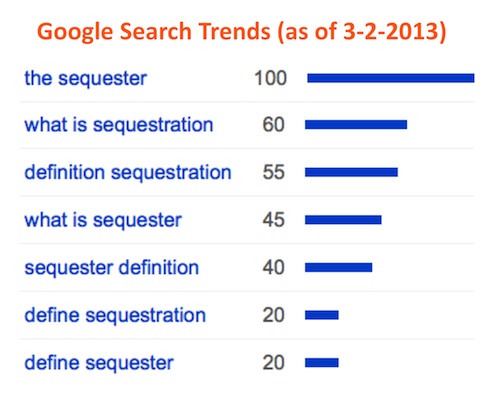
The sequester. Will it work? Hope so, but only time will tell. One positive outcome is already certain: Americans have been expanding their vocabulary. According to Google Trends constrained to the USA, interested folks have been "googling" definitions of sequestration and sequester, as the chart below shows (100 is peak search volume).


So, the nation is learning this word. However, in "Letting Sequester Fester" -- published in Word Routes  only 12 days ago -- linguist Ben Zimmer is a tad cautious:
"A bigger problem is that most people still don't know what sequester means; as Time's Katy Steinmetz noted, a poll in The Hill indicated that 25 percent of voters said that they didn't know what sequester referred to, while almost 40 percent guessed the wrong answer." (See poll results).
Ben's concern is well founded, at least in my case. Who knew sequestration had anything to do with spending? I did not, until recently. Prior to 2012,  the main context I had for sequester derived from movies like Runaway Jury and high profile court cases, where jurors are sequestered in hotel rooms lest they become tainted, bribed, biased.

In addition to the courtroom context, I may have happened upon sequester in a few other places. In the sports column for the Seattle Times:

"Outside of Daytona, teams are rarely sequestered at one track for five days"

In literature I may have run across Phillpotts (1920):

"Time rings his rounds and forgets not this sequestered hollow."

That's a beautiful line, and even memorable, but still I did not associate sequester with the economy. So how did I learn about fiscal sequestration? The same way we learn many words -- from a variety of context, supported by an accessible definition. Yes, I am among the "googlers" mentioned above. Now I know this other meaning of sequestration. I also know sequester, used as a verb, to sequester, and also as a noun, the sequester (the verb was only recently converted into a noun, through a process described in a prior post).

So what?


IMPLICATIONS FOR TEACHING AND LEARNING

My own processing -- or learning -- of this word rather neatly flows with the five aspects of word complexity discussed in a chapter by vocabulary experts William Nagy and Judith Scott (2000). The five aspects that describe the complexity of word knowledge often overlap. All five aspects may not apply to every word.  According to the scholars, educators need to consider the following when teaching any given word:

1) Incrementality: As I have personally experienced with sequester, we do not immediately gain full understanding of a word meaning, but instead, we gradually and incrementally refine our knowledge, through various encounters with the concept, in varied context. As long as I only encountered sequester in the context of a jury, my grasp was limited. Teaching implications: Revisit words over time, in varied genres, applications, and uses. Provide for distributed practice. Avoid "vocabulary cramming" for a test.

2) Polysemy: Many words have more than one meaning, as we have seen with sequester. The most commonly used meaning is the one we are most likely to know. Teaching implications: Help students attend to context to grasp meaning. Explicitly teach multiple meanings. Teach dictionary use. Teach the metalinguistic notion that word meanings are flexible, and apt to change.

3. Multidimensionality: Words are learned along various dimensions. These dimensions may overlap.  Teaching implications: Help students pronounce the word, read it, spell it, use it correctly in terms of grammar and syntax.  Teach the conceptual meaning and its associations with other words, including morphological relationships, discussed below. Help students attend to collocations -- the words the target word "hangs out" with, including the little-noticed words: "in" sequestration, for one example. Discuss style and register. Sequestration is more formal than budget cuts and likely to be used in academic discourse. To develop a formal register within a discipline, try some of the "Accountable Talk" strategies discussed by Dr. Zygouris-Coe in a prior post.

Visual Thesaurus
4. Interrelatedness: Knowing one meaning actually implies that we know other related meanings. That should be more than evident with sequestration.  Teaching implications: Students are unlikely to understand budget sequestration unless they already understand the simple concepts of save and keep, and more abstract concepts, like reduce, withhold, percentage, budget, etc. Build on prior learning, and convey word relationships (synonyms, antonyms, derivations, conceptual or thematic clusters, etc.). Help students learn to use a dictionary and thesaurus, to further deepen their understanding.

5. Heterogenity: Words vary in complexity, and so do word learners. The content word sequestration is more complex than the content term budget cuts, and far more complex than the function word within. Teaching implications: Provide differentiated instruction, depending on the word, and depending on the learner.

MORPHOLOGICAL REASONING

Learning about how words are formed with roots and affixes is part of developing metalinguistic insight, and as such, it promotes both vocabulary and comprehension. Because vocabulary growth hinges on an understanding of word structure, Nagy and Scott (2000) claim the following, in the same chapter discussed above:

 "It is hard to overstate the importance of morphology in vocabulary growth" (p. 275)

With sequester, older students could explore the family of words that flow from the Latin root, which means something like, 'to place in safe keeping' (see Robertson).  Partners could discuss the semantic overlap across these morphologically related words and analyze the word structure to see how the different suffixes and prefixes, smacked onto the root, modify the meaning and/or grammatical word class (noun, verb, adjective, or adverb).
sequester     sequestration     sequestrator     sequestrate     sequestral   
sequestrant     sequestrable      unsequestrable     unsequestered 

Sequestrate words in isolated study lists? Not sound practice. Provide some context and a student-friendly definition. Explore morphological families of words.

Work together with a peer, practicing how to pronounce difficult words. Like sequestration. Now that's a tricky one. A tongue twister. Gain confidence and competence. Then use the word in formal, academic discourse.

I've been sequestered in my office long enough. Best wishes, until next time.


References:
Nagy, W. E., & Scott, J. A. (2000). Vocabulary processes. In M. L. Kamil, P. B. Mosenthal, P. D. Pearson, & R. Barr (Eds.), Handbook of reading research: Volume II (pp. 269–284). Mahwah, NJ: Erlbaum.


To be notified when a new post is published, enter your email address into Feedburner.
When Feedburner sends you a verification email, confirm to activate your subscription.

Sunday, February 3, 2013

Getting "In" to Prefixes


Greetings! This month, I wrote a guest post titled Getting "in" to Prefixes for Visual Thesaurus/Vocabulary.com.  If interested, see link below.

But first, stay a while and browse. Scroll down for a few posts, dig into the archives (see links above), read an entry from a guest author (see links in sidebar), or explore the dozens of websites listed at the bottom of the page.

Getting "in" to Prefixes may seem familiar, because I have expanded upon an older post. The extended article includes a discussion of academic words beginning with the prefix in-, (e.g., inflammable, incandescent, and invaluable), an interactive sorting activity (download the page and freely distribute), and pertinent Common Core State Standards for English / Language Arts.

Enjoy!

Monday, September 17, 2012

On Politics and Word Meaning (with video)

I begin with Mark Forsyth's entertaining video clip discussing the etymology of a few political terms and conclude with George Orwell's more serious essay on politics and communication.

A number of Vocabulogic posts have explored how words tend to change in form, meaning, and usage over time, referencing the study of etymology. For example, in one post I describe how the Common Core State Standards include the study of etymology in high school English classes. See Etymology and Morphology Standards. In another post, Shane Templeton discusses how word meanings change over time and are "more than the sum of their parts".

Along the same lines, I offer an interesting video, courtesy of TED Talks. With plenty of humor and some embellishment, etymologist Mark Forsyth makes the point that words change meaning based on the usage at the time. Try as we might, we cannot control word meaning, nor cast it in cement. It is likely to take on a life of its own. Speechifiers take note!
Forsyth states:
"Politicians try to pick words and use words to shape reality and control reality, but in fact, reality changes words far more than words can ever change reality.”
Forsyth discusses two political terms, snollygoster and president. What's a snollygoster?  By the sound of the word, and knowing it is used to describe politicians, I suppose we can all guess.

Of more relevance, Forsyth explores how the term president came to reference the "chief executive officer for the US" and how its connotations have drastically changed since first applied to George Washington. The bit about the US Senate may be somewhat apocryphal, as some have suggested, but the story is entertaining and provides us with word-sleuthing material.

This short video might perhaps be interesting to secondary and tertiary students studying civics, US History, or etymology. The video runs 6.26 minutes, published June 2012. Watch it below, or view it directly at the site, TED.com.


Politicians and Language: 

How do the words we use reflect our personality? James (Jamie) W. Pennebaker, a psychologist at the University of Texas, analyzed the speech patterns used during the debate between President Obama and Governor Romney. His analysis includes the use of pronouns and function words as well as content words and positively or negatively charged phrases. He compares the two candidates to former Presidents Clinton, Bush, and Reagan. View his brief interview at Wordwatcher,  a You Tube channel hosted by UT Austin. You might be surprised at his analysis.

ALSO, if the relationship between words, ideas, and communication interests you, see George Orwell's essay, Politics and the English Language, published in 1946. I found it online, courtesy of Vincent Ferraro, Professor of International Politics at Mount Holyoke.

Citing five excerpts from various publications, Orwell shows how words can muddle our thinking -- how easily we can confuse ourselves and our audience with unclear language -- and not necessarily intentionally. But politicians on both sides of the aisle have been known to muddy the waters, as Orwell shows. He offers sound advice for anyone who wants to improve both their thought processes and their communication, concluding with the following statement:
Political language -- and with variations this is true of all political parties, from Conservatives to Anarchists -- is designed to make lies sound truthful and murder respectable, and to give an appearance of solidity to pure wind. One cannot change this all in a moment, but one can at least change one's own habits, and from time to time one can even, if one jeers loudly enough, send some worn-out and useless phrase -- some jackboot, Achilles' heel, hotbed, melting pot, acid test, veritable inferno, or other lump of verbal refuse -- into the dustbin, where it belongs.

Sunday, August 5, 2012

Etymology & Morphology Standards (survey results)

The Common Core State Standards (CCSS) provide learning goals for grades K-12. These new objectives have been adopted by 45 states (see map). In this post, I discuss the CCSS that pertain to etymology and morphology and argue that the Standards do not adequately address etymology. I begin with the survey results and conclude with websites and books for teaching etymology.


The survey reveals a somewhat keen  interest in word origins for more than half the respondents (72 of 127 voters). Given the readership of Vocabulogic, this is perhaps not surprising, but it is promising. If teachers are interested in something, students are more likely to become interested, too (especially if they like the teacher). In his classic work, Principles of Teaching, Thorndike (1906) suggested that the second cause of interest is the force of imitation; he argued that students will be interested in whatever interests the community—including their teachers and fellow students—and the interest will be acquired almost by infection.

DO THE STANDARDS INCLUDE MORPHOLOGY?
Yes, in the CCSS, the English Language Arts (ELA) Standards include morphological awareness (knowledge of word structure, especially via affixes and roots). While morphological awareness (MA) is never mentioned per se in the Standards, the related content is included as a sub-skill across every grade, K-12. However, to find the standards that apply to MA, one must search around a bit, hunting in the various domains under ELA: Reading, Language, Foundational Skills. Search for the terms inflectional endings, suffixes, prefixes, affixes, compound words, Greek and Latin roots. Below is one example standard, showing the morphology bits, from grade 3:

Determine or clarify the meaning of unknown and multiple-meaning word and phrases based on grade 3 reading and content, choosing flexibly from a range of strategies.
  • Determine the meaning of the new word formed when a known affix is added to a known word (e.g., agreeable/disagreeable, comfortable/uncomfortable, care/careless, heat/preheat). 
  • Use a known root word as a clue to the meaning of an unknown word with the same root (e.g., company, companion).

WHAT ABOUT ETYMOLOGY?
Etymology is the study of how words have changed in form, meaning, and usage over time, including the origins of words--whether a word was first used by the ancient Greeks, for example. See prior post and see post by Shane Templeton.

Etymology is almost forgotten in the Common Core ELA Standards. The search term etymology appears only twice (!!) across the entire document, K-12. The search term word origins is not found at all.  The standard first appears in grades 9-10 and repeats in grades 11-12:

Determine or clarify the meaning of unknown and multiple-meaning words and phrases based on grades 9–10 reading and content, choosing flexibly from a range of strategies.
  • Consult general and specialized reference materials (e.g., dictionaries, glossaries, thesauruses), both print and digital, to find the pronunciation of a word or determine or clarify its precise meaning, its part of speech, or its etymology. 

Hmm. It seems to me that the etymology bit was almost an afterthought. The language is certainly not strong, and only applies to high school. Why is etymology given slight attention? I know not. But, in support of this decision, researchers have not sufficiently explored how etymological insight relates to either morphological insight, vocabulary knowledge, or even orthographic knowledge (how to spell).

On the other hand, learning about word histories might be viewed as one way to make the word stick. If we know why a word is so named, and have a sense of its history, we might better remember it. Vocabulary researcher Stephen Stahl explained it like this, in his book Vocabulary Development (1999, pp 22-23):
"Telling word stories can make words memorable. Knowing that bilious comes from the medieval humor, bile, which caused anger...makes the word more memorable"
Likewise, knowing that robot originally meant "forced laborer or slave' (from Czech robotnik "slave," from robota "forced labor, drudgery") makes the word far more interesting, more three dimensional, cognitively "sticky" or memorable, and infused with history. In my view, learning etymology reinforces the study of history, and the reverse is also true.

There is another reason to include word origins long before high school. English freely adopts foreign loan words (prior post). English contains words from dozens--if not hundreds--of other languages. It is important to be aware of this fact, especially from a spelling perspective.

IMPLICATIONS for INSTRUCTION
I would not suggest spending a lot of time on word histories, but I see no reason to wait until high school to integrate the history of the word into the vocabulary lesson--with the caveat that this need only happen occasionally, and only if the etymology is interesting. Likewise, why not infuse etymology lessons into history lessons, where applicable and interesting?

Students might start exploring brief word histories as soon as they have a sense of the world and can read a world map--certainly by fourth grade. This should help them remember meanings, spell words, and pronounce words. Perhaps learning about word histories will help students realize that English is only one of many languages of the world. Indeed, it might help them become interested in learning another language.

RESOURCES: BOOKS AND WEBSITES FOR TEACHING ETYMOLOGY
Abracadabera to Zombie: More Than 300 Wacky Word Origins by Don and Pam Wulffson (short and sweet little etymologies, aimed at about grade 4)

Frindle, a chapter book aimed at about 5th grade, by Andrew Clements (fast paced and fun, used by many teachers)

A History of English in its Own Words, by Craig Carver (word histories provided, organized by time period: Anglo Saxon/Old English, French-based Middle English, Renaissance, etc.)

The Professor and the Madman: A Tale of Murder, Insanity, and the Making of the Oxford Dictionary, aimed at older students or adults, by Simon Winchester (a riveting read)

Douglas Harper's site: Online Etymology Dictionary

Ben Zimmer's website: Word Routes

Dave Wilton's website: Wordorigins.org 

Michael Quinion's website: World Wide Words 

Barry Popik's website: Barry Popik.com

Charles Hodgson's podcasts: Podictionary

Oxford English Dictionary: Oxford Online

Anu Garg's website: A Word a Day at Wordsmith.org

Fun with Words website: Etymology Section

References: 

Stahl, S. A. (1999). Vocabulary Development. Cambridge, MA: Brookline Books.

Thorndike, E. L. (1906). The Principles of Teaching: Based on Psychology. A. G. Seiler: New York.

Sunday, March 18, 2012

What is Disciplinary Literacy and Why Aren’t We Talking More About it? (Zygouris-Coe)

In this post, Dr. Vicky Zygouris-Coe discusses theory and offers practical applications for helping older students develop disciplinary literacy. Vassiliki ("Vicky") Zygouris-Coe is an Associate Professor of Education at the University of Central Florida, College of Education. Her research focuses in literacy in the content areas, online learning, and teacher professional development. Dr. Zygouris-Coe has impacted reading instruction in the state of Florida through the Florida Online Reading Professional Development project—Florida’s first online large-scale project for preK-12 educators. Her work has been published in a variety of professional journals. She serves in several editorial roles, including Co-Editor of Literacy Research and Instruction, Associate Editor of both the Florida Educational Leadership and the Florida Association of Teacher Educators Journal.

What is Disciplinary Literacy?
Shanahan and Shanahan (2008, 2012) propose that disciplinary literacy, advanced (and specialized) literacy instruction embedded within content-area classes such as math, science, and social studies, should be a core focus of literacy efforts for middle and high school grades. Disciplinary literacy “involves the use of reading, reasoning, investigating, speaking, and writing required to learn and form complex content knowledge appropriate to a particular discipline” (McConachie & Petrosky, 2010, p. 16). According to this perspective, definitions of literacy in the secondary grades must be anchored in the specifics of individual disciplines. Disciplinary literacy highlights the complexity, literacy demands, and differentiated thinking, skills, and strategies that characterize each discipline.
Disciplinary literacy is built on the premise that each subject area or discipline has a discourse community with its own language, texts, and ways of knowing, doing, and communicating within a discipline (O’Brien, Moje, & Stewart, 2001). It moves beyond the notion of “every teacher is a reading teacher” and literacy as an “add-on” set of generic strategies used to improve the reading and writing of subject area texts. Rather, it situates literacy as an integral part of content (Moje, 2008) so that “literacy within the discipline” becomes the goal of disciplinary literacy.” (Zygouris-Coe, 2012, p. 4)
Findings from the Shanahan and Shanahan (2008) study suggest that each discipline (e.g. history, chemistry, mathematics) carries different cognitive and literacy demands. Participants in Shanahan’s and Shanahan’s (2008) study varied in the way the read, in what they considered to be challenges in the text, and in how the texts should be taught. For example, comprehension can be challenging with mathematics when text is extremely dense and students need to understand the flow of information from print to numeracy, to graphs. Vocabulary can be challenging in chemistry due to extensive technical vocabulary in the discipline. Whereas in history, vocabulary can be challenging due to the many dated words and metaphorical terms. In terms of discipline-specific strategies, for example, sourcing, contextualizing, identifying arguments and how the author portrays events, etc. are useful to history. In chemistry, separating essential from non-essential information, visualizing, and thinking of examples are some of the strategies that fit the content demands. Lastly, explaining concepts, writing equations, and illustrating data are some of the strategies that would help students read and comprehend text in mathematics.

Some of the challenges we are facing with preparing students to succeed in disciplinary literacy include literacy professionals’ lack of knowledge of each discipline to be able to provide teachers with specific tools to teach students the kinds of knowledge, literacies, language, and inquiry different experts (e.g., mathematics, science, history) use. In addition, content area teachers lack knowledge in the literacy demands of their discipline. As a result, we have many adolescents who cannot read and comprehend text in different disciplines—we must prepare teachers to develop students’ discipline-specific knowledge and skills (Lee & Spratley, 2010; Moje, 2008; Shanahan & Shanahan, 2008; Snow & Moje, 2010). As educators, we need to develop our knowledge of the unique structure, goals, practices, texts, and discourse of each discipline and how knowledge is created and shared (Fang, 2004; Fang & Schleppegrell, 2008; Geisler, 1994; Halliday, 1998; Schleppegrell, 2004).

Why Aren’t We Talking More About Disciplinary Literacy?
We are living in the midst of high accountability and educational reform. The Common Core State Standards (CCSS) have been adopted by most states and will be implemented in 2014. The CCSS call for literacy within each discipline, for critical thinking of complex texts, for complex knowledge development, and for evidence-based reading, writing, and speaking. Disciplinary literacy tasks are situated within the CCSS. So, why aren’t we talking more about disciplinary literacy efforts or initiatives in secondary pre-service teacher preparation and in-service teacher education?
Shanahan and Shanahan (2012) discuss the existing mixed perspectives about what literacy in the content areas should look like. In addition, they highlight that disciplinary literacy is not a new term for reading across the content areas. Disciplinary literacy refers to the knowledge, discourse, and habits of mind necessary for learning in each discipline (McConachie & Petrosky, 2010); it is not just about a set of strategies for reading and writing across the disciplines. Also, vocabulary learning is not about using core effective strategies to help students memorize or make connections among concepts; there are unique discipline differences that we should take into consideration in each subject area. Students need to learn the scientific vocabulary of each discipline and specific tools to develop and analyze it—they need to learn (and use) the language of each discipline, its grammar, patterns, and uses.

In my opinion, there should be more discussion among educators and researchers about disciplinary literacy, more learning about it in professional learning communities (PLCs), and planning for instruction that would meet both the content and literacy demands of each discipline. We need to get away from using generic strategies that only help students organize text and focus on helping students learn how to think, read, talk, write, communicate, and inquire in ways that are consistent to each discipline. This paradigm shift from generic to discipline-specific literacy would help bring about the development of content, literacy, and thinking skills we have been longing to see in our adolescents’ learning. Of course, this shift would require a different way of teaching and learning in secondary content area classrooms and schools and a different approach to teacher preparation and professional development. We need more dialogue, research, collaborations, and direction on this topic. In the following section, I will focus on one aspect of the disciplinary learning framework, that of accountable talk (McConachie & Petrosky, 2010).

Accountable Talk to Support Disciplinary Literacy Learning
We know from research that students learn best when they are actively involved in their own learning. How can teachers maintain student engagement in, and facilitate ownership of, learning? One way they can do it is through modeling, promoting, and facilitating accountable talk in each content area. Accountable talk is an important component of a disciplinary literacy-learning framework (McConachie & Petrosky, 2010). It is talk that supports the development of student reasoning and their ability to verbalize their thinking (Michaels, O’Connor, Hall, & Resnick, 2002). Accountable talk is talk that reflects student understanding of words and concepts read or discussed in class, participation in co-construction of meaning, and monitoring of meaning as it is “molded” from student to student in class. Accountable talk is respectful of everyone’s ideas. Everyone is expected to participate actively in discussions, listen attentively, and expand on ideas. In addition, everyone is accountable to knowledge building, to providing sufficient evidence for assertions, and to rigorous thinking. According to this type of talk, everyone is “accountable” to the development of meaning “by all and for all.”

Accountable talk will help teachers to “revoice” students’ comments and prompt them to provide additional support for their assertions. It will also help teachers to provide further insight into student knowledge and use higher-level vocabulary while still maintaining contact with student ideas. Students will benefit from teacher modeling, feedback, scaffolded support, and a positive and collaborative learning classroom environment.

Here are some basic examples of accountable talk.
  • I have something to say about…
  • I agree with ______ because…
  • I disagree with _______ because…
  • I wondered about…
  • Is this your main point?
  • Can you prove that …?
  • I have a question for _______ about…
  • Could you repeat what _______ said?
  • Could you say more about that?
  • Do you agree or disagree with what ________ said? Explain your thinking.
  • Could you give us an example?
  • Could you elaborate more on the meaning of this word?
  • Do you agree or disagree with _________ statement?

Accountable talk will vary according to content area as a result of each discipline’s structure, goals, ways of thinking and learning, vocabulary, and texts. For more information on discipline-specific examples of accountable talk, please see Figure 1.

Figure 1. Examples of accountable talk in four disciplines. This figure illustrates sample discipline-specific questions that can promote student engagement, use of specialized vocabulary, and learning in each discipline.

Conclusion
Disciplinary literacy includes the use of reading, thinking, speaking, inquiring, and writing required to learn and develop complex content knowledge appropriate to a particular discipline (McConachie & Petrosky, 2010); it is not about a set of generic tools transplanted into the discipline to improve reading and writing of content-specific texts (Moje, 2008; Shanahan, 2012). A focus on disciplinary literacy will help students develop content knowledge and critical literacy thinking skills needed for success in school, college, and career.

Resources
To learn more about disciplinary literacy, please examine the following resources.
  1. Dr. Timothy Shanahan’s blog: Shanahan on literacy.
  2. Topics in Language Disorders (January/March, 2012). Themed Issue on Disciplinary Literacy.
  3. University of Pittsburg, Institute for Learning.

References
  • Fang, Z. (2004). Scientific literacy: A functional linguistic perspective. Science Education, 89, 335–347. 
  • Fang, Z., & Schleppegrell, M. (2008). Reading in secondary content areas: A language-based pedagogy. Ann Arbor, MI: University of Michigan Press.
  • Geisler, C. (1994). Academic literacy and the nature of expertise: Reading, writing, and knowing in academic philosophy. Mahwah, NJ: Lawrence Erlbaum.
  • Halliday, M. A. K. (1998). Things and relations: Regrammaticising experience as technical knowledge. In J. R. Martin & R. Veel (Eds.), Reading science: Critical and functional perspectives on discourses of science (pp. 185–235). London, UK: Routledge.
  • Lee, C. D., & Spratley, A. (2010). Reading in the disciplines: The challenges of adolescent literacy. New York, NY: Carnegie Corporation of New York.
  • McConachie, S. M., & Petrosky, A. R. (2010). Content matters: A disciplinary literacy approach to improving student learning. San Francisco, CA: Jossey-Bass.
  • Michaels, S., O’Connor, M. C., Hall, M. W, & Resnick, L. B. (2002). Accountable talk: Classroom conversation that works. (Version 2.1). [Online resource]. Pittsburgh, PA: University of Pittsburgh.
  • Moje, E. B. (2008). Foregrounding the disciplines in secondary literacy teaching and learning: A call for change. Journal of Adolescent and Adult Literacy, 52(2), 96-107.
  • Schleppegrell, M. J. (2004). The language of schooling: A funcilinguistics perspective. Mahwah, NJ: Lawrence Erlbaum.
  • Shanahan, T., & Shanahan, C. (2008). Teaching disciplinary literacy to adolescents: Rethinking content-area literacy. Harvard Educational Review, 78(1), 40-59.
  • Shanahan, T., & Shanahan, C. (2012).What is disciplinary literacy and why does it matter? Topics in Language Disorders, 32(1), 7–18.
  • Snow, C. E., & Moje, E. B. (2010). What is adolescent literacy? Why is everyone talking about it now? Phi Delta Kappan, 91(6), 66-69.
  • Zygouris-Coe, V. (2012). Disciplinary literacy and the common core state standards. Topics in Language Disorders, 32(1), 35-50.

Sunday, February 5, 2012

Polysemous Prefixes over- and under- (Survey Results)

Thanks for participating in the recent survey! The prefixes under- and over- are among the top 20 most commonly used prefixes, according to the The American Heritage Word Frequency Book (Carroll, Davies, & Richman, 1971). According to that source, in the school texts examined, the prefix over- was the 8th most common, and the prefix under- was the 20th most common. More Words shows 406 words that begin with the letter string under and 1,681 words that begin with over.

The poll is closed. The results are shown below, and general discussion follows, including application to the Common Core State Standards and implications for instruction.

Post publication note: Most of the words in the survey are compound words. In the comments below, the point is made that over- and under- are not actually prefixes, but instead bases. Please see the comments for more elaboration on this excellent point.


Frankly, I had a tough time responding to this poll myself (yes, I know, I created it!!). Trying to be devious (do I get absolution for admitting that?), I included a word that begins with the prefix un-, yet looks like under- (underived). I also included a word that is misspelled (*overian, for ovarian). No one fell for my tricks (attributing the 2% to statistical error for underived).

The survey question that surprised me was #2: underage--undersized. I expected more people to view these two words as sharing the same prefix, with the same meaning 'not enough, insufficient' but only 72% did so (136 of 190 respondents). Not sure why. I could be missing something important. I was also surprised by overlearn--overboard (I view them as different senses of the prefix) and by overfed--overnight (different, I'd say). Some words are just too nuanced for me, as with underlying--undergoing. A colleague thought they do share the same meaning, where the prefix means 'beneath, under'. She said, "Any underlying cause rests beneath all the symptoms, and when you undergo surgery, you go under anesthesia, or under the knife." If we can get students to explain their thinking in such ways, we are hitting the jackpot.

Think Map, Visual Thesaurus
To help me understand one survey item, I turned to the Visual Thesaurus. The Think Map to the left, generated for the targeted word underhanded, helps explain why 32 respondents felt that underarm and underhanded shared the same sense of the prefix. One colleague said that underhanded and underarm are different, because underarm suggests something spatial, directional, and physical, like a baseball pitch, but underhanded suggests something hidden and covert (sneaky, as shown in the Think Map). However, another colleague disagreed, stating that her husband is a coach, and her first thought was that you can throw an underarm pitch or an underhanded pitch (also included in the Think Map). Context matters! Prior experiences with the word make a difference! Instructional discussions matter, too.

Rather than going over each survey item, let's discuss the various meanings of the prefixes and several instructional applications. (Even without knowing the "right answer" to the survey items, the thought process is beneficial. This is an exercise teachers might share with students, but using known words, and providing some context.)

Native English speakers and Dual Language Learners might assume that over- means 'on top of, above' and under- means 'beneath, below' (as in overcoat, undershirt) but that is not the only interpretation. Over- also suggests 'too much' and under also suggests 'insufficient, not enough' (as in overexcited and underexposed). Words that contain the prefixes over- and under-  are more likely to suggest the notion of 'too much' or 'not enough', compared to a spatial meaning.

These are broad interpretations of the two prefixes. However, a closer consideration reveals more than two meanings for each prefix. Michael Quinion, at Affixes.org, provides a brief summary of the various interpretations of the prefix over-.  He states, "Its meanings are rather variable and diffuse, and difficult to categorize."  (Yes, indeed!)

Quinion describes multiple ways the prefix over- is used to convey word meaning:
1) suggests 'something beyond what is usual or desirable, even excessively so' (overambitious, overcareful, overfull, overprecise)

2) suggests ‘utterly’ or ‘completely’ (overawed, overjoyed, overcome) [as in overcome with emotion]

3) suggests 'a spatial sense of something above or higher up' (overhang, overarching, overlook)

4) suggests a figurative sense of 'something that is superior' (overseer, overlord, oversight committee)

5) suggests something 'outer' (overcoat, overshoes)

6) suggests something 'extra' (overtime, overpay) [an oxymoron]

7) suggests 'a motion forward and down, and hence of inversion' (overturning, overbalance, overthrow, overboard)

8) suggests 'covering a surface' (overpaint, overgrowth).

Implications for instruction: I can see no reason why a typical language user needs to know all these nuanced senses of the prefix, but school children should know the most commonly used interpretations. Furthermore, they should learn to think about this type of word analysis. With so many nuanced meanings of the prefix over- (and the prefix under-) it is clear that we cannot rely on simply memorizing lists of morphemes and their meanings. We might also encourage children to think about how morphemes and words interact together, with context, to convey meaning. The value is in the critical thinking and the discussion that students engage in when working collaboratively through these types of questions. Tip: When asking students to sort meanings, an "other" category is useful, for those words that are difficult to classify, and an "unknown" category helps separate the others from the unknowns.

Why bother? Teaching children to think in these ways increases their level of morphological awareness. Readers who reflect on various aspects of language are more likely to comprehend words, phrases, and passages (see post on metalinguistic awareness). In addition, interpreting affixes is one of the learning goals outlined in the Common Core State Standards for English Language Arts.

Application to The Common Core State Standards
      Vocabulary Acquisition and Use

  • L. 1. 4 [First Grade] Use frequently occurring affixes as a clue to the meaning of a word.
  •  L.2.4 [Second Grade] Determine the meaning of the new word formed when a known prefix is added to a known word (e.g., happy/unhappy, tell/retell).
  • L. 3. 4 [Third Grade] Determine the meaning of the new word formed when a known affix is added to a known word (e.g., agreeable/disagreeable, comfortable/uncomfortable, care/careless, heat/preheat).
    Source: English Language Arts Standards (Language subsection)
Questionable Lesson Plan: I searched the Web and found a lesson plan for teaching the prefix over-. I won't name the site, but it was not related to the Common Core. According to the webpage, the lesson applies to Grades 2 and 3.  I was happy to see the lesson, but only one meaning of over- is taught. Here is an excerpt:
Step 4. Define the meaning of over-, as well as words containing the prefix over-.  Look at the list of words with the prefix over-. Who knows what over- means? Over- means “too much.” Look at overwork. Overwork means “to work too much.” When the prefix over- is added to work, it changes the meaning of the word. Can anyone tell us what overslept means? What about overdo?
There is no additional instruction, no mention of the other meanings of over-, but the good news is that this is the most frequently occurring sense of the prefix. Nonetheless, students --and teachers-- who try to interpret overnight, overseer, and overcoat with the notion of 'too much' will run into trouble (especially since there is no context provided).

Note: Vocabulogic readers have participated in a number of surveys on common affixes. For examples, see The Popular Prefix in- (Survey)  and The Slippery Suffix -er (Survey).

Sunday, January 8, 2012

Metalinguistic Awareness, Comprehension, and the Common Core State Standards

Coordinated by the National Governors Association Center for Best Practices (NGA Center), the Common Core State Standards have swept the nation, and nearly every state has sanctioned the call for students to read more complex texts. In response, publishers are rapidly preparing more challenging texts, referring to the exemplars listed in Appendix B of the Standards, including works by Sophocles, Alexis de Tocqueville and Fyodor Dostoevsky. These types of texts will be Waterloo for some students, and the battle begins in kindergarten with a call to understand—and hopefully enjoy—As I was Going to St. Ives. How can teachers help readers meet this challenge? In part, the solution lies in developing metacognitive insights and abilities—including metalinguistic awareness.

Metalinguistic awareness requires a keener than normal conscious awareness of language. We demonstrate this type of metacognition when we remove language from context in order to reflect on it and manipulate it. Metalinguistic awareness is an important ingredient in learning to read, spell and understand words (Donaldson, 1978). Moreover, as Nagy suggests, it explains a portion of the otherwise unexplained variance in comprehension scores, when other important variables have been controlled (2007). Boosting metalinguistic awareness has significant effect on reading comprehension (Cain, 2007; Zipke, 2007, 2011; Zipke, Ehri, & Cairns, 2009). English Language Learners benefit from metalinguistic awareness, too, including metamorphological awareness (Carlo et al., 2004; Ginsberg, Honda, O’Neil, 2011; Kuo & Anderson, 2006; Ramirez, Chen, Geva, & Kiefer, 2010).

Metalinguistic awareness is a cognitive dynamo. At maximum potential, it includes increased awareness of phonemes and syllables and rhymes/rimes, of meaning-bearing morphemes, words, and phrases, of syntax, word referents, and appositives, of denotations, connotations, and lexical ambiguities, of homonyms, synonyms, and antonyms, of slang, dialect, and jargon, of academic language and figurative devices like metaphor, imagery, personification, and more. Writ large, metalinguistic awareness envelops every atom of language.

Researchers have long proclaimed the critical role of phonological awareness (PA) in helping children blend and segment sounds in words. In the past decade, two more types of metalinguistic insight have surfaced repeatedly in reading research journals: morphological awareness (MA) and orthographic awareness (OA). If a student grows in MA, s/he becomes increasingly aware that words sharing the same base or root are similar in form and meaning. For example, the child notices similarities across painted, painter, paintings, painterly, and repaint, at the same time realizing that pain –while somewhat similar in form—is not related to this morphological family. MA also includes knowledge of common suffixes and prefixes.

If a student grows in OA, s/he becomes more aware of the English system of writing, realizing that something “just looks wrong” when presented with “illegal” spellings, such as words beginning with ck or words containing three identical vowels in a row, as in *seeer. As this insight matures, students gradually realize that foreign loan words allow the inclusion of spellings not aligned with English orthography, as in beau, hoi polloi, and faux pas.

Recently, Berninger, Abbott, Nagy, and Carlisle (2010) conducted a longitudinal study spanning first grade to sixth grade in two cohorts (N = 241 students), investigating growth curves for three types of metalinguistic awareness: MA, OA, and PA. They found that PA and receptive OA grew from first to third grade and then tapered off or reached a plateau, for most students. Expressive OA continued to grow a bit after third grade. Meanwhile, MA grew rapidly from first to third grade and then continued to grow, but less rapidly, through sixth grade. Furthermore, MA influenced word knowledge: Vocabulary knowledge was significantly related to how well the student understood that derivational suffixes influence the grammatical category of the word—for example, that instrument is not grammatically the same as instrumentalist or instrumentally, even though there is semantic overlap. Reading comprehension is partially explained by growth in MA (Kuo & Anderson, 2006; Nagy, Berninger, & Abbott, 2006).

As educators, we promote metalinguistic awareness by making explicit the salient aspects of the targeted linguistic concept—for example, the logic behind understanding multiple-meaning words, drawing an inference, or grasping how compound words convey meaning morphologically. We promote keener consciousness when we point out how any detail of language works, making our thoughts transparent in a think-aloud with visual modeling, or when we ask students to explain their reasoning—and we give them feedback. If we exploit metalinguistic insight, we influence word reading, spelling, and vocabulary while moving the ball towards the end goal: comprehension.Thus, we might heed the clarion call of linguist Bill Nagy (2007):
“Vocabulary instruction needs to be more explicitly metalinguistic, that is word consciousness is an obligatory, not an optional, component” (p. 54). 

What about the brave new Common Core? Do they mention the term metalinguistic in the English Language Arts Standards? Alas, no. However, Appendix A circles loosely around the topic (NGA Center & CCSSO, 2010):
The reader brings to the act of reading his or her cognitive capabilities (attention, memory, critical analytic ability, inferencing, visualization); motivation (a purpose for reading, interest in the content, self-efficacy as a reader); knowledge (vocabulary and topic knowledge, linguistic and discourse knowledge, knowledge of comprehension strategies); and experiences.
In another section of the document, metacognitive strategies are mentioned. The Standards, and the forthcoming standards-aligned assessments, are fairly agnostic to instructional methods—they do not care HOW we teach—only that students learn. Professional discretion is encouraged; teachers and administrators decide how to address the Standards, including how to develop metacognitive insight, as indicated in Key Design Considerations:
By emphasizing required achievements, the Standards leave room for teachers, curriculum developers, and states to determine how those goals should be reached and what additional topics should be addressed. Thus, the Standards do not mandate such things as a particular writing process or the full range of metacognitive strategies [formatting added] that students may need to monitor and direct their thinking and learning. Teachers are thus free to provide students with whatever tools and knowledge their professional judgment and experience identify as most helpful for meeting the goals set out in the Standards.
To my knowledge, the term metacognitive only appears once in the CCSS, in the insert above. By integrating the two excerpts above, one might (might) infer that the National Governors Association did indeed include metalinguistic development in the Common Core. I only wish they had been more deliberate about it.

Without conscious awareness of language, second graders may be frustrated by The Jumblies (another exemplar text, by Edward Lear). Indeed, if lessons do not include an explicit focus on metalinguistic awareness, we could be sending whole schools to sea—in a sieve.

~Susan M. Ebbers

References: 

Berninger, V.W., Abbott, R.D., Nagy, W., & Carlisle, J. (2010). Growth in phonological, orthographic, and morphological awareness in grades 1 to 6. Journal of Psycholinguistic Research, 39, 141–163.

Cain, K. (2007). Syntactic awareness and reading ability: Is there any evidence for a special relationship? Applied Psycholinguistics, 28, 679-694.

Carlo, M.S., August, D., McLaughlin, B., Snow, C.E., Dressler, C., Lippman, D., Liveley, T. & White, C.E. (2004). Closing the gap: Addressing the vocabulary needs of ELLs in bilingual and mainstream classrooms. Reading Research Quarterly, 39, 188-215.

Donaldson, M. (1978). Children’s minds. Glasgow: Collins.

Ginsberg, D., Honda, M., & O’Neil, W. (2011). Looking beyond English: Linguistic inquiry for English Language Learners. Language and Linguistics Compass 5/5, 249-264.

Kuo, L-J., & Anderson, R. C. (2006). Morphological awareness and learning to read: A cross-language perspective. Educational Psychologist, 41-3, 161-180.

NGA Center & CCSSO. (2010). The common core state standards for English language arts. Retrieved December 13, 2011 from http://www.corestandards.org/the-standards/english-language-arts-standards

Nagy, W.E. (2007). Metalinguistic awareness and the vocabulary-comprehension connection. In R.K. Wagner, A.E Muse, & K.R. Tannenbaum (Eds.), Vocabulary acquisition: Implications for reading comprehension (pp. 52-77). New York: Guilford Press.

Nagy, W., Berninger, V., & Abbott, R. (2006). Contributions of morphology beyond phonology to literacy outcomes of upper elementary and middle school students. Journal of Educational Psychology, 98(1), 134-147.

Ramirez, G., Chen, X., Geva, E., & Kiefer, H. (2010). Morphological awareness in Spanish-speaking English language learners: Within and cross-language effects on word reading. Reading and Writing, 23(3-4), 337-358.

Zipke, M. (2007). The role of metalinguistic awareness in the reading comprehension of sixth and seventh graders. Reading Psychology, 28(4), 375-396.

Zipke, M. (2011). First graders receive instruction in homonym detection and meaning articulation: The effect of explicit metalinguistic awareness practice on beginning readers. Reading Psychology, 32(4), 349-371.

Zipke, M., Ehri, L. E., & Cairns, H. (2009). Using semantic ambiguity instruction to improve third graders’ metalinguistic awareness and reading comprehension: An experimental study. Reading Research Quarterly, 44(3), 300–321.

_________________

Note:  This post was republished in EdView360 and in the CDL Professional Library

Sunday, November 13, 2011

The Rise of New Media, The Fall of Printed Books

New release: Just out this month, Houghton Mifflin Harcourt offers up The American Heritage Dictionary of the English Language, Fifth Edition I have been using the Fourth Edition for about a decade, with no complaints. Because this resource provides etymological information as well as denotations and illustrations, I referred to it when writing my supplemental curriculum: Vocabulary through Morphemes, now in its Second Edition.

How has Houghton Mifflin Harcourt (HMH) advertised the Fifth Edition of the dictionary? Marketing materials caught my interest with one question:
"Will this be the last print dictionary ever made?" 
Relative to this provocative question, the publishers made the book available in print,  online, and via a smartphone app. The question posed by HMH is probably precipitous, for not everyone has access to an e-reader. According to a March 2011 report by the National Association of College Stores, only about 15% of college students own any type of e-reading device (see post by Charles Schmidt). This percentage reflects an increase over prior years. It is logical to assume the numbers will continue to rise in future but it is also logical to assume that comparatively fewer K-12 school children have access to e-readers in the home. Perhaps they have access to the Internet at home. Perhaps not.

Recent trends indicate the end is coming--the age of print is already past its zenith. Certainly we have seen the rise of digital news over newsprint. Further, a number of magazines have transformed from print publishing to Web-based. For example, in 2009, Ecologist made the decision to stop printing their magazine, in favor of a digital version. See Why the Ecologist Has Gone Online, by Zac Goldsmith of The Guardian.

Students need to effectively use digital media as well as legacy media. The recently adopted Common Core State Standards reflect the expectation that students will become adept at learning from a variety of sources. Below, I show relevant English Language Arts Standards for grades five and six:
English Language Arts Standards: Reading: Informational Text: Integration of Knowledge and Ideas

Grade 5. RI.5.7.  Draw on information from multiple print or digital sources, demonstrating the ability to locate an answer to a question quickly or to solve a problem efficiently.
Grade 6. RI.6.7. Integrate information presented in different media or formats (e.g., visually, quantitatively) as well as in words to develop a coherent understanding of a topic or issue.
The standards indicate that adolescents are expected to draw wisely from new media and from old, to further along the quest for information and deeper understanding. This assumes a great deal, not least the availability of both types of media, but the goal is spot on.

The standards notwithstanding, even as digital technology moves forward at speed, reading research lags behind. The Web offers a number of advantages for fact finding and for social interaction, but when it comes to the psychology of reading, despite the hype for high-tech, there is little evidence supporting a learning advantage for children who use e-readers, apps, or engage otherwise in online reading. We do not know enough about whether e-books enable fluent reading in younger students, nor do we know enough about the conditions under which web-reading and e-books might best facilitate vocabulary growth or comprehension in older students. The adjustment to digital reading is complicated, from a cognitive perspective, in large part because the Web is designed to distract. The adjustment to Web-reading involves more than the relatively superficial transformation seen when society moved from reading scrolls to reading books or from listening to cassettes versus CDs. At this point, a great deal is unknown. Work is underway; researchers are investigating these urgent issues and more. See prior post on processing digital text.

Getting back to the marketing campaign for the Fifth Edition, linguist Ben Zimmer addresses the portentous question posed by HMH in his post, Is this the last print dictionary?  Another expert, Dennis Baron, discusses the marketing gimmick with a post titled The last print dictionary.  Each writer explores the future of printed books.

What say you? Will digital dictionaries replace printed volumes, or is HMH asking the wrong question, making it dichotomous? This query might apply to novels, children's books, textbooks, etc. Gabrielle E. Miller, guest writer for the electronic Washington Post, offers a perspective: Must we have the digital versus print battle?

Classroom application: Along these lines, I offer a bit of verse for preteens and young adolescents, to elicit discussion and debate regarding the relative merits of printed texts and digital media. Is the age of books coming to an end? If so, what of it?
The Age of Books

Crated, carted, cast aside,
printed works have liquefied
in shocking bouts of bookicide.
The printing press is done, perhaps,
and publishers have (boom!) collapsed
to clicky gadgets, gizmos, apps.

Digital books are all the rage,
touchless paper, turnless page.
Stores are only cyber spaces,
cold, electric, faceless places.

Bookshops closed, bookshelves cleared,
paperbacks have disappeared.

The age of print has culminated,
finished, finis, terminated.
                          ******

Make free use of the poem. I wrote it from a growing awareness of how new technology is influencing teaching, learning, and society in general at many levels. To prompt the spirit of debate I have taken a side, and it does reflect my love for books, but I see value in high tech and old, and I enjoy using my e-reader.

Want more? See the video for the book, titled It's a Book, by Lane Smith. Also, see the You Tube video The Help Desk, featuring medieval monks making the transformation from scroll to book. 

~Susan